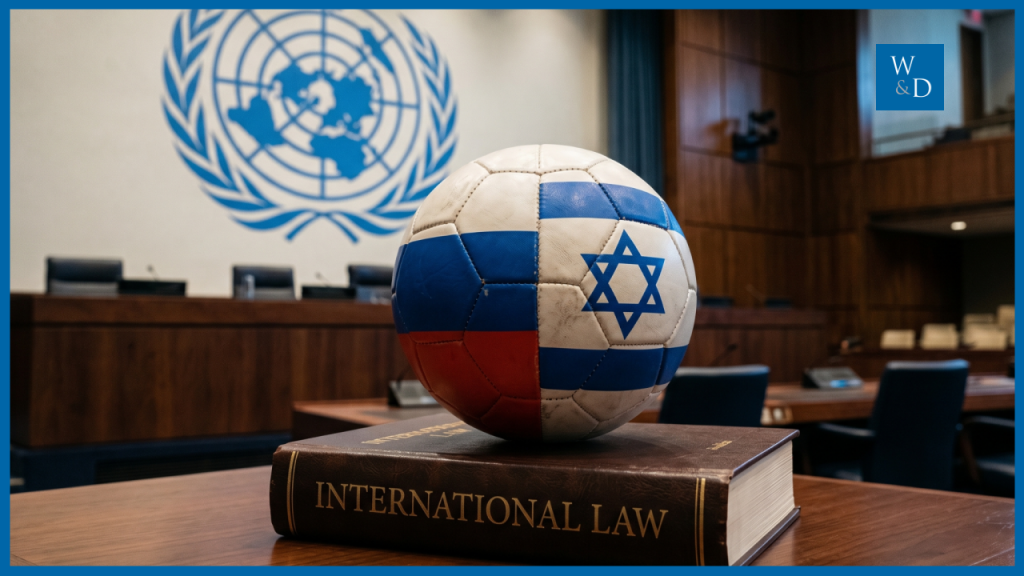
Russia vs Israel : Double Standards in Sports Sanctions?
Author: Lucio Mazzei 🇮🇹
Lawyer
The article is also available in French and Spanish:


Published by the firm WD Associés
When Russia invaded Ukraine in 2022, the reaction from global sport was swift, coordinated, and unprecedented. Leading governing bodies such as FIFA, UEFA and the International Olympic Committee imposed far-reaching measures: exclusion of Russian national teams and clubs from international competitions, suspension of events, and the admission of athletes only under a neutral flag.
These were not merely symbolic acts. The invasion was widely deemed as a grave breach of international law and overwhelmingly condemned by the United Nations General Assembly
Faced with intense political, economic, and public pressure, sports institutions aligned with this broad international consensus to protect:
• the integrity of competitions;
• the safety and security of participants;
• their own institutional legitimacy;
In practical terms, maintaining Russia’s full participation had become unsustainable. This brings us to a more complex and uncomfortable question
ALSO READ: Legal explanation of the sports sanctions imposed on Russia
Why has Israel not faced comparable sporting sanctions in relation to the Palestinian situation?
From a legal standpoint, the key distinction lies in the absence of a unified international consensus. Unlike the Russia–Ukraine case, Israel’s actions have not been evaluated in a consistent and widely accepted manner across the international community. State positions remain deeply divided, shaped by geopolitical alliances and strategic considerations.
This lack of consensus has direct consequences within the sporting ecosystem:
- no coordinated global pressure on governing bodies;
- no widespread refusal by national teams to compete;
- no systemic disruption of competitions;
In the absence of these dynamics, organizations such as FIFA and UEFA have adopted a significantly more cautious stance.

Photo: pixabay.com
The legal framework helps explain why:
International sports law does not provide a clear, codified regime for sanctioning States in response to violations of international law. As a result, governing bodies operate within a broad discretionary space, where legal principles intersect with political realities.
ALSO READ: Diarra affair : Seism on the transfer market
As consistently affirmed by the Court of Arbitration for Sport, this discretion is acceptable provided that core principles such as proportionality, non-discrimination and due process are respected. However, this leads to an inherent structural tension.
When sanctions are driven by geopolitical alignment rather than objective legal standards, the system risks appearing inconsistent, if not selective.
Key takeaway:
Global sport is not insulated from international politics: its decisions reflect a complex interplay of law, pressure and power!
LEGAL NOTICE: This article has been prepared for informational purposes only. It is not a substitute for legal advice directed to particular circumstances. You should not take or refrain from taking any legal action based on the information contained without first seeking professional, individualized advice based on your own circumstances. The hiring of a lawyer is an important decision that should not be based solely on advertisements.
If you want advice related to the subject of the
article do not hesitate to contact us!
(email: contact@wdassocies.com)



This site is protected by reCAPTCHA and the Google Privacy Policy and Terms of Service apply.